
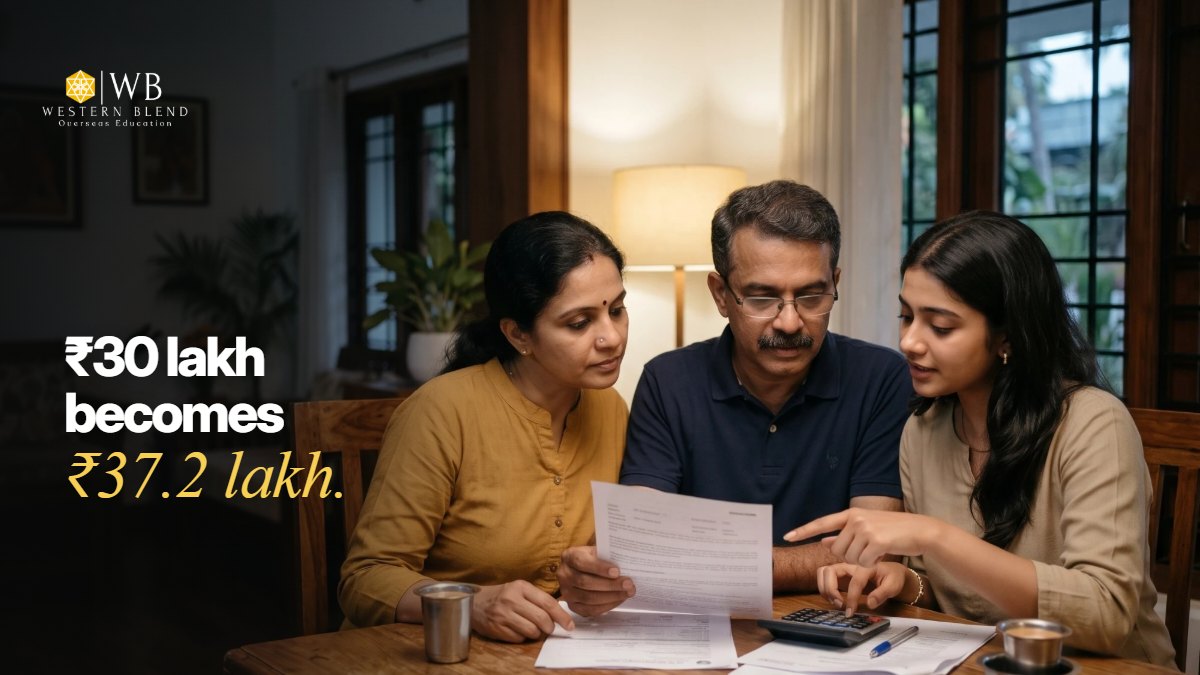
Most families know the loan amount. Very few know the amount they’ll owe on the day the first EMI starts. Interest usually starts the day the money is paid out, and it keeps adding up while you study. Here’s the maths, done for you.
Your balance when EMIs start
Example: a 2-year master’s plus a 6-month grace period (30 months before the first EMI), at 9.65% simple interest (SBI Global Ed-Vantage with collateral; girl students get 0.50% off), with the full amount paid out on day one.
| Loan | Interest while you study | Balance when EMIs start |
|---|---|---|
| ₹20 lakh | ₹4.8 lakh | ₹24.8 lakh |
| ₹30 lakh | ₹7.2 lakh | ₹37.2 lakh |
| ₹40 lakh | ₹9.7 lakh | ₹49.7 lakh |
Your EMI for 10 years
| Loan | EMI a month | Total you repay over 10 years |
|---|---|---|
| ₹20 lakh | ₹32,300 | about ₹38.8 lakh |
| ₹30 lakh | ₹48,500 | about ₹58.2 lakh |
| ₹40 lakh | ₹64,700 | about ₹77.6 lakh |
So a ₹30 lakh loan can cost close to twice the amount borrowed by the time it’s paid off.
The one thing that cuts your EMI
Pay only the interest while you study. On ₹30 lakh, that’s about ₹24,100 a month. Then your balance when EMIs start stays at ₹30 lakh, not ₹37.2 lakh, and the EMI falls to about ₹39,100 instead of ₹48,500.
Over the whole loan, that saves about ₹4 lakh. If a parent can manage the monthly interest during the course, it’s usually worth it.
Another saver: if your bank pays the loan out in instalments (each semester’s fee when it’s due), interest builds up only on what’s been paid out, so you owe less.
If you come back to India, can you still pay?
This is the fear behind most questions we hear: “Will I get a job, or come back with a loan?”
A common rule of thumb is to keep loan EMIs under 40% of take-home pay. For a ₹48,500 EMI, that means a take-home salary of about ₹1.2 lakh a month. Many entry-level jobs in India pay far less, so plan for this before you borrow:
- Borrow less: compare public universities with low tuition (Germany, Italy, France, Austria and others) before private ones.
- Pay the interest during the course (above).
- Choose a country where you have time to work after graduating, so you can repay part of the loan in a stronger currency. (See our guide on jobs after graduation, country by country.)
6 questions to ask the bank before you sign
- Is the interest during my course simple or compound?
- Is the rate fixed or floating, and how much will my EMI rise if it goes up by 1%?
- When exactly does the first EMI start?
- Will you pay out the loan all at once or in instalments?
- Does the loan cover living costs and the visa funds I need to show, or tuition only?
- What are the processing fee, insurance and prepayment charges?
Tax: a small help
Interest on an education loan can be claimed under Section 80E of the Income Tax Act for up to 8 years, with no upper limit, but only if you file under the old tax regime. Check with a tax adviser which regime suits you.
FAQ
Does interest really start before I finish the course?
For most education loans, yes. Interest is charged from the day the money is paid out, even if you don’t pay anything until after the course.
Bank or NBFC?
Public-sector banks are often cheaper, especially with collateral. NBFCs can be faster and may lend without collateral, usually at a higher rate. Compare the total cost, not just the rate.
Can I repay early?
Many banks allow part-prepayment on floating-rate education loans without a penalty. Ask in writing.
Want us to work out your number?
Send us your loan amount, course length and country, and we’ll show you what you’d owe and how to bring it down, as part of a free consultation. WhatsApp +91 70124 63160.
This is an example to help you plan, not financial advice. Your bank’s rate, fees and terms decide the real figures.
Sources and assumptions: SBI Global Ed-Vantage rate with collateral, 9.65% (from 15 Oct 2026), sbi.co.in education loan interest rates · simple interest during the course and grace period, full amount paid out at the start, 10-year repayment · Income Tax Act Section 80E (incometaxindia.gov.in) · questions from Reddit r/Indians_StudyAbroad threads on loan repayment (Nov 2026).